As an Amazon Associate this site earns from qualifying purchases.
Comparison table
| Camera | Price | Max video | Sensor | Battery | Waterproof |
|---|---|---|---|---|---|
| DJI Osmo Action 5 Pro | Check price on Amazon | Not stated (4K) | 1/1.3", 2.4 µm | 1950mAh, up to 4 hrs | IP68 to 20m |
| DJI Osmo Action 6 | Check price on Amazon | 8K | 1/1.1" square | Up to 4 hrs | Not stated |
| DJI Osmo Action 4 | Check price on Amazon | 4K/120fps | 1/1.3", 2.4 µm | 1770mAh, up to 150 min | 18m |
| GoPro LIT Hero | Check price on Amazon | 4K60 | Not stated | Not stated | 16ft (5m) |
| AKASO Brave 4 | Check price on Amazon | 4K30 | Not stated | 2 × 1050mAh, 90 min each | 131ft (case) |
| AKASO EK7000 | Check price on Amazon | 4K30 | Not stated | Not stated | 131ft (case) |
Quick answer: If you want the best all-round camera for YouTube work, the DJI Osmo Action 5 Pro is the one to beat — big sensor, 360° HorizonSteady, and a battery rated up to 4 hours. Creators on a tight budget should look at the AKASO Brave 4, which ships with two batteries and dual screens for under $70, while anyone chasing maximum resolution for reframing should stretch to the 8K DJI Osmo Action 6.
Action cameras have quietly become the default second camera for YouTube channels — small enough to clamp anywhere, tough enough to survive a shoot, and now good enough in low light that you're not automatically switching to a mirrorless body the moment the sun goes down. The six cameras below cover roughly a $70-to-$500 spread, and the differences between them are bigger than the price tags suggest.
DJI Osmo Action 5 Pro — Best Overall
The DJI Osmo Action 5 Pro Essential Combo, Waterproof Action Camera is the sensible centre of this list at $309. It uses a 1/1.3" sensor with 2.4 µm pixels and a 13.5-stop dynamic range, which is the spec that matters most if you shoot indoors, at dusk, or anywhere your lighting isn't under your control.
Finding the right best action cameras for youtube creators comes down to matching the features to how you will actually use it.
For YouTube specifically, two features earn their keep. The first is subject centring driven by a 4nm chip, which keeps a fast-moving subject framed in either 16:9 or 9:16 — meaning one recording can feed both your main channel and your Shorts. The second is 360° HorizonSteady, which cancels roll-axis shake and keeps the horizon level, so handheld walk-and-talks don't tilt drunkenly when you gesture.
Practical stuff: a 1950mAh battery rated up to 4 hours of recording, or 3.6 hours at -20°C, and IP68 rating for 20m underwater. Dual OLED touchscreens front and rear mean you can frame yourself without a monitor. Read through recent buyer reviews yourself before ordering — that's the fastest way to see whether the current firmware behaviour matches what you need.
DJI Osmo Action 6 — Best for maximum resolution
At $496 the DJI Osmo Action 6 Enhanced Combo, 8K Waterproof Action Camera is the priciest camera here, and the reason to buy it is the 1/1.1" square sensor feeding 8K video. A square sensor plus 8K capture is a genuinely useful combination for creators: the 4K Custom Mode lets you reframe a single shot into multiple aspect ratios, so a horizontal YouTube upload and a vertical Shorts cut can come from the same take without cropping into mush.
It's also the only camera on this list with a variable aperture — f/2.0 to f/4.0 — which adapts across bright and dark scenes rather than leaving exposure entirely to shutter and ISO.
Stabilisation comes in two flavours: RockSteady 3.0, which smooths footage while keeping the first-person feel of motion, and HorizonSteady, which corrects horizontal tilt at up to 4K/60fps. Battery is rated up to 4 hours in normal conditions with a cold-resistant design. Gesture and voice control let you start recording without walking back to the camera, which is the single most useful thing a solo creator can have.
DJI Osmo Action 4 — Best for low-light value
The DJI Osmo Action 4 Essential Combo, Waterproof Action Camera Vlogging Camera sits at $229 and carries the same 1/1.3-inch sensor with 2.4 µm pixels as the Action 5 Pro. That's the headline: you're getting the big-sensor low-light advantage for $80 less than its successor.
What you get on top is a genuinely creator-focused feature set. 10-bit colour depth and D-Log M give you real latitude in the grade, which matters if you're colour-matching action footage to A-roll from another camera. The 155° ultra-wide field of view at 4K/120fps means minimal cropping when you stabilise, and 120fps gives you clean slow motion.
The 1770mAh battery is rated up to 150 minutes and works down to -20°C, with waterproofing to 18m. The magnetic quick-release mount switches between horizontal and vertical in seconds — a small thing that saves real time when you're shooting for two platforms in one session.
GoPro LIT Hero — Best for shooting in the dark
The GoPro LIT Hero - Lightweight, Compact, Waterproof Action Camera with Built-in Light, 4K60 Ultra HD Video, 12MP Photo, Touch Screen, HyperSmooth Stabilization is $189.99 and does something nothing else here does: it has a light built into the body. Three brightness settings, and it works when the camera is off or while it's plugged in and charging — so it doubles as a small fill light on a desk or a lamp when you're rummaging in a bag at 5am.
It's positioned as the entry-level GoPro, with simplified tap-and-swipe controls between video, photo and slo-mo. Video tops out at 4K60, which gives you 2x slow motion on playback, plus 12MP stills and the ability to pull up to 11MP frames from video in the GoPro Quik app.
Two caveats worth naming honestly. Waterproofing is 16ft (5m) — fine for rain, pools and shallow snorkelling, well short of the DJI cameras' depth ratings. And the 12MP photo resolution is lower than the AKASO cameras' 20MP. In the box: the camera, a light diffuser, curved adhesive mount, mounting buckle and thumb screw, and a USB-C cable.
AKASO Brave 4 — Best budget pick
At $69.98, the AKASO Brave 4 Action Camera 4K30 Ultra Hd Waterproof Underwater Camera is the better of the two cheap options here, and the reason is the accessory bundle: two rechargeable 1050mAh batteries and a USB dual charger, each battery good for up to 90 minutes. That's roughly three hours of run time out of the box on a camera that costs less than a single DJI battery pack.
It shoots 4K30 down to 1080p60 with 20MP photos, and has four selectable field-of-view settings — 170°, 140°, 110° and 70°. That last one is genuinely handy for talking-head clips where a 170° lens distorts your face. A built-in gyroscope handles stabilisation.
There's a 2" rear screen and a 0.96" front screen, so you can check framing when the camera is pointed at you. Wi-Fi and HDMI are both included, with Wi-Fi range up to 10 metres. Waterproofing is 131ft with the case fitted. Note the remote wristband is not waterproof.
AKASO EK7000 — Best for a first camera you won't cry over
The AKASO EK7000 4K30FPS 20MP WiFi Action Camera with EIS Ultra HD 131FT Waterproof Underwater Camera Remote Control 4X Zoom Support External Microphone Black is $69.99, and for YouTube creators one spec stands out: it supports an external microphone. Nothing else on this list is described as doing that, and audio is where cheap cameras usually fall down hardest.
It records 4K30 and 2.7K30 with 20MP photos, has built-in electronic image stabilisation, and is waterproof to 131ft in its case. There's 4X zoom, Wi-Fi with about 10 metres of range for transfers via the AKASO GO app, and a 2.4G wrist remote for starting recordings when the camera is out of reach — though, again, that remote isn't waterproof.
Two things to budget for: no microSD card is included, and no second battery is mentioned, so the Brave 4's twin-battery bundle is the more complete package at essentially the same price.
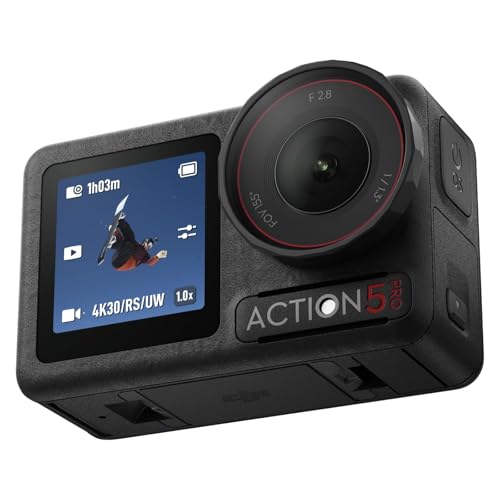
- Pro-Grade Night & Dynamic Imaging - Discover breathtaking imaging quality with Osmo Action 5 Pro action camera 4K and its all-new 1/1.3" sensor. Advanced tech with 2.4 µm large
- Always Centered, Always Focused - Achieve pinpoint accuracy with our advanced 4nm chip. DJI Osmo Action 5 Pro vlogging camera keeps fast-moving subjects perfectly centered in 16:9
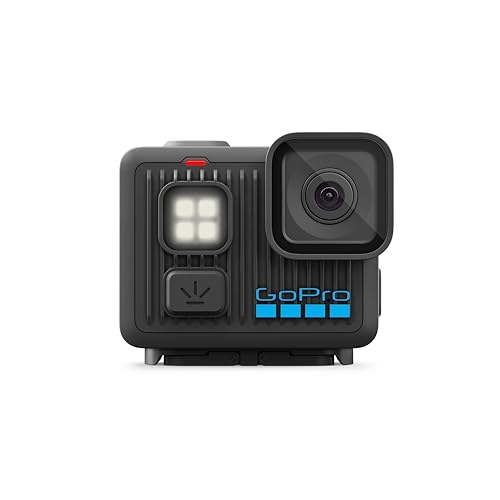
- The Perfect Entry-Level GoPro: Simplified controls let you easily tap and swipe between video, photo and slo-mo modes
- Rugged + Waterproof to 16ft (5m): Completely waterproof and built with legendary GoPro durability, LIT HERO is ready to capture the fun whether you’re ripping through mud, snow or
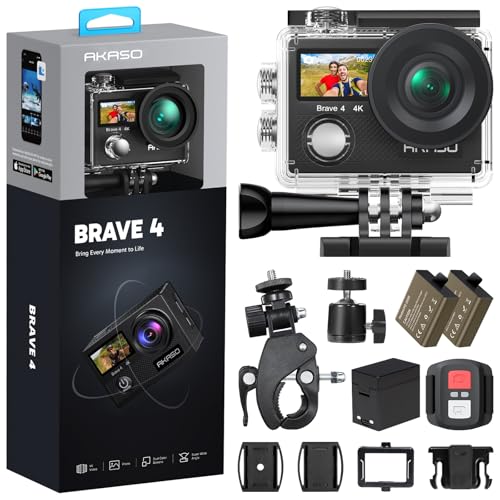
- 4K30fps Video & 20MP Photo: Capture every detail of life’s most beautiful moments with video resolutions from 4K 30fps to 1080P 60fps and 20MP photos so you can relive them
- 170° Adjustable View Angle and Image Stabilization: With four customizable viewing angles of 170°, 140°, 110°, and 70°, capture the perfect perspective for any situation. Built-in
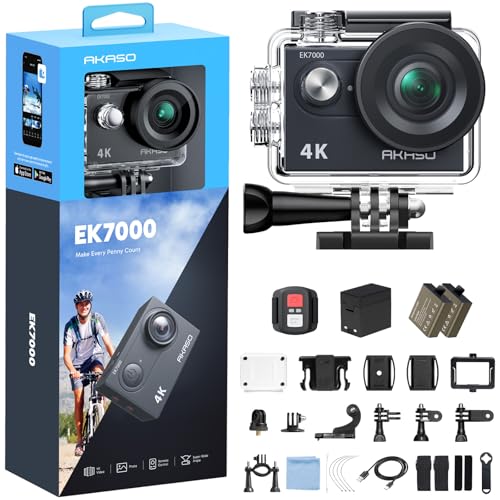
- 4K Ultra HD action camera: Professional 4K30Fps & 2.7K30Fps video with 20MP photos at up to 30 frames per second for incredible photos, which is 4 times the resolution of
- Smooth Stabilization: Built-in Electronic Image Stabilization (EIS) delivers steady and smooth videos. It can enable excellent footage even you or the object is in fast-moving
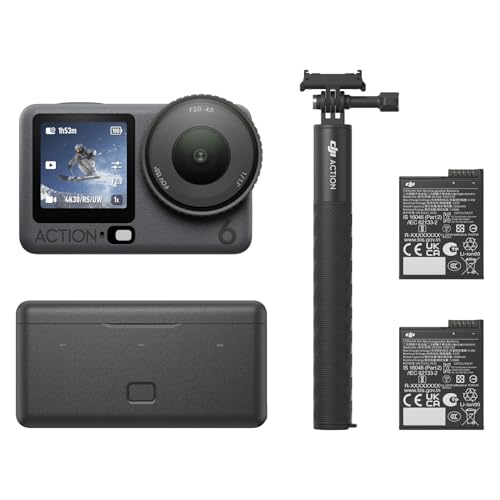
- Capture Every Scene, Day or Night - Variable aperture f/2.0 [1]-f/4.0 adapts for crystal-clear 8K video[23] in any light. Superior low-light performance delivers crisp results
- Detailed Action in Every Frame - The all-new 1/1.1″ square sensor boosts this action camera's image quality, delivering vibrant colors and sharp 8K video [23]. With the 4K Custom
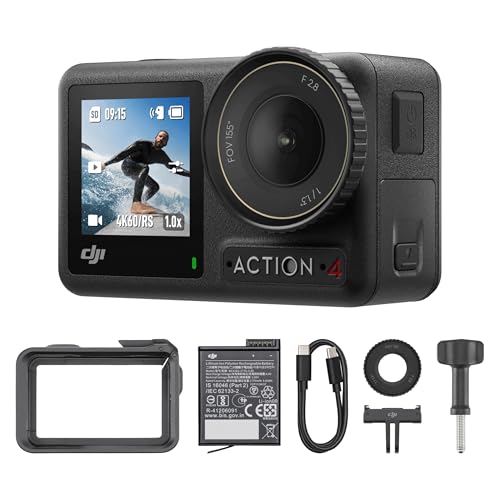
- Superior Low-Light Performance with 1/1.3-inch Sensor - Struggling with grainy footage in low light? Osmo Action 4 action camera 4K uses 2.4μm pixel size for crisp results. Auto
- Pro-Grade Color Science - Worried your videos lack real-life colors? 10-bit color depth captures subtle shades, while D-Log M preserves more detail and dynamic range for
How to choose
Sensor size beats resolution. A 1/1.3" or 1/1.1" sensor with 2.4 µm pixels collects meaningfully more light than the small sensors in budget cameras. If you shoot indoors, in the evening, or in variable light, the Action 4, Action 5 Pro and Action 6 are in a different category from the AKASO pair — and the Action 4 gets you there for $229.
Stabilisation type matters more than the marketing name. Basic EIS or gyroscope stabilisation, as on the AKASO cameras, smooths shake. HorizonSteady on the Action 5 Pro and Action 6 additionally corrects roll, keeping the horizon flat when the camera rotates. For handheld vlogging on the move, that's the difference between watchable and nauseating.
Vertical is not an afterthought. If Shorts are part of your plan, look for cameras that address it directly: the Action 5 Pro's subject tracking works in 9:16, the Action 6's 4K Custom Mode reframes into multiple aspect ratios, and the Action 4's magnetic quick-release flips to vertical in seconds.
Battery is the hidden cost. The Action 5 Pro and Action 6 are both rated up to 4 hours; the Action 4 is 150 minutes. The Brave 4 solves the problem the cheap way — two batteries and a dual charger in the box.
Audio is where budget cameras lose. Of the six, only the EK7000 is specified as supporting an external microphone. If you're talking to camera, that's not a small detail.
Front screens. The Brave 4 (0.96" front), Action 5 Pro (dual OLED) and Action 4 all let you see yourself while recording. If you shoot solo, prioritise it.
FAQ
Is an action camera good enough as a main YouTube camera? For vlogs, travel and anything handheld or mounted, yes — particularly the larger-sensor DJI models with 10-bit colour and D-Log M for grading. For sit-down talking-head content, the wide lenses and limited audio inputs are the constraint, not the image quality.
Do I need 8K? Only if you plan to reframe or crop. The Osmo Action 6's 8K capture and square sensor exist so you can cut one take into several aspect ratios. If you upload 4K and shoot each format separately, the Action 5 Pro at $309 does more for your money.
Which of these handles cold weather? The Osmo Action 4 and Action 5 Pro are both specified to work at -20°C (-4°F), with the Action 5 Pro rated for 3.6 hours of recording at that temperature. The Action 6 is described as having a cold-resistant design.
Are the $70 AKASO cameras actually usable for YouTube? They shoot 4K30 with 20MP stills and have stabilisation, so the footage is publishable. What you give up is low-light performance, advanced stabilisation and colour latitude. Go and read current buyer reviews on the listing to see how they're holding up for people shooting the kind of content you make.
Related guides
- Terms and Conditions
- Expert Advice on Best drones, gimbals and content creator gear - camera drones, smartphone gimbals, action cameras, ring lights and stream decks
- Why Rates Vary for Best drones, gimbals and content creator gear - camera drones, smartphone gimbals, action cameras, ring lights and stream decks
Key Takeaways
- Choosing the right best action cameras for youtube creators means matching the key features to your specific needs and budget
- Read real customer reviews and check the return policy before you commit
- Compare value across models — the priciest option is not always the best fit